
Loading recent posts...
Showing posts with label Agricultural Mechanization. Show all posts
Showing posts with label Agricultural Mechanization. Show all posts
Agricultural mechanization is the application of agricultural engineering principles, tools, machinery, and power sources to make farm operations more timely, efficient, reliable, and commercially viable. It covers crop production, livestock, horticulture, irrigation, transport, storage, processing, and other post-harvest activities. Appropriate mechanization can reduce drudgery and production time, improve the quality of field operations, and expand the range of tasks that farmers can perform.
Overview and Objectives of Agricultural Mechanization
Modernization in agriculture involves adopting scientifically sound technologies that are technically suitable, economically feasible, socially acceptable, and appropriate to local conditions. Commercialization extends this process by using improved technologies to produce goods and services for the market.
Agricultural mechanization includes equipment ranging from simple hand tools to powered machinery used for land preparation, seeding, transplanting, irrigation, weeding, spraying, fertilizer application, harvesting, threshing, transport, storage, and processing. It also supports livestock and horticultural operations, including feed preparation, milking, shelter cleaning, pruning, intercultural operations, and specialized harvesting.
Purpose of Agricultural Mechanization
- Improve the efficient use of human, animal, and mechanical energy.
- Reduce production costs, drudgery, and the time required for farm operations.
- Complete agricultural operations within the appropriate seasonal window.
- Improve productivity and the quality of agricultural production.
- Perform operations that are difficult or impractical using only human or animal power.
- Create opportunities for employment, entrepreneurship, and rural service businesses.
- Support agricultural commercialization and rural industrialization.
- Improve the livelihoods of farmers, service providers, traders, and consumers.
Farmers' Needs and Mechanization Challenges
Mechanization is particularly relevant where farmers face labor shortages, delayed field operations, high production costs, low productivity, and limited access to appropriate technologies.
Why mechanization is needed
- Seasonal labor shortages and the migration of rural youth.
- Low agricultural production and productivity.
- High drudgery and the cost of traditional farming practices.
- Difficulty completing land preparation and other operations on time.
- Increasing areas of fallow or underutilized agricultural land.
- Weak use of economic analysis in machinery and farm-management decisions.
- Limited information about suitable technologies and service providers.
- Declining interest among young people in agriculture.
- Weak competitiveness in national and international markets.
- The need to improve product quality while reducing production costs.
- The need for technologies suitable for women, older farmers, and diverse users.
Constraints to machinery adoption
- High purchase prices for agricultural machinery.
- Small and fragmented landholdings.
- Limited technical knowledge and operator skills.
- Shortages of trained mechanics and machinery-service personnel.
- Difficulty obtaining repairs, maintenance, and spare parts.
- Limited labor for machinery operation and support activities.
- Low annual machinery use, which increases the payback period.
Collective ownership and machinery-hiring arrangements can reduce these constraints by spreading capital, maintenance, and operating costs across a larger number of users.

Technical Support for Farmers and Service Providers
Technical organizations can support farmer groups, custom hiring centres, machinery owners, and other service providers through the following activities:
- Training on safe machinery operation, repair, and preventive maintenance.
- Technical advice for selecting and purchasing suitable machinery.
- Field testing and evaluation of new machines and implements.
- Research and recommendations on appropriate cultivation methods.
- Information on machinery suppliers, dealers, repair services, and service providers.
- Support for business planning, financing, and financial management.
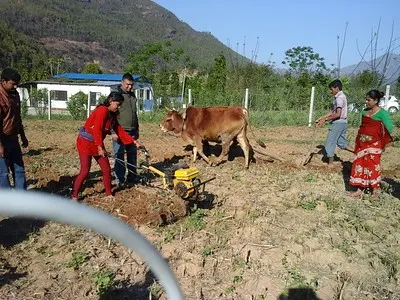
Custom Hiring Centres and Machinery Services
A custom hiring centre (CHC) is a shared machinery-service arrangement through which smallholder and marginal farmers can access agricultural machinery without purchasing every machine themselves. Machinery may be owned and managed by a community, cooperative, farmer group, government agency, private enterprise, dealer, or another service provider. Farmers normally pay according to the area covered, the operating time, or the specific service delivered.
Custom hiring services can improve machinery utilization and make mechanization more affordable where individual ownership is constrained by small farms, high capital costs, limited technical skills, and low annual machine use.
Why machinery-hiring services are needed
- Declining and fragmented landholding sizes.
- Limited ability of individual farmers to purchase multiple machines.
- Limited technical knowledge and operating skills.
- Insufficient annual use to justify individual ownership.
- Opportunities for machinery owners and operators to earn service income.
- Convenient access through private providers, cooperatives, groups, or public agencies.
Functions of a custom hiring centre
- Demonstrate and promote appropriate agricultural technologies.
- Make machinery and related services available to farmers and other customers.
- Identify machinery suited to local crops, terrain, farm size, and production systems.
- Provide operator training, skill development, and vocational training.
- Conduct awareness and extension activities using suitable communication channels.
- Improve farm timeliness, productivity, income, and machinery-use efficiency.
Illustrative Machinery and Services
| S.N. | Farm operation | Illustrative machinery and equipment |
|---|---|---|
| 1 | Land preparation and tillage | Mini tiller, power tiller, tractor, laser land leveler, rotavator, disc plough, mouldboard plough, and cultivator |
| 2 | Seeding and transplanting | Seed drill, planter, rice transplanter, Happy Seeder, and dibbler |
| 3 | Fertilizer application | Top dresser, fertilizer spreader, and related applicators |
| 4 | Irrigation | Surface and submersible pumps, solar irrigation pumps, diesel or petrol pumps, and axial-flow pumps |
| 5 | Weeding | Manual weeder, power weeder, mini-tiller weeder, and tractor-mounted weeding equipment |
| 6 | Spraying | Knapsack sprayer, compression sprayer, pedal sprayer, solar-powered sprayer, and battery-operated backpack sprayer |
| 7 | Harvesting | Mower, mini reaper, two-wheel-tractor reaper, four-wheel-tractor reaper, combine harvester, mini combine harvester, and brush cutter |
| 8 | Threshing | Pedal thresher, open-drum thresher, axial-flow thresher, and multicrop thresher |
| 9 | Hay and residue management | Straw reaper, baler, forage harvester, and mulcher |
| 10 | Transport | Two-wheel-tractor and four-wheel-tractor trailers or trolleys |
| 11 | Cleaning and grading | Seed cleaner, grader, and combined seed cleaner-cum-grader |
| 12 | Drying | Mobile and stationary crop dryers |
| 13 | Processing | Disc mill, hammer mill, huller, sheller, and oil-expelling or oil-extraction equipment |